What the model is looking at, why confidence scores matter more than a yes/no answer, and where visual weapon detection genuinely can and can't help.
"AI weapon detection" gets sold with a lot of confidence and very little explanation. Buyers are told a camera will "see a gun" the way a person would — instantly, certainly, every time. That's not how any of these systems work, including ours. This is a plain description of the actual mechanism: what the model is doing frame by frame, why a confidence score is a more honest unit than a yes/no answer, and where the physics of a camera feed put a hard ceiling on what visual detection alone can promise. If a vendor tells you their weapon detection is 100% accurate under any condition, that claim itself is the first thing to be skeptical of.
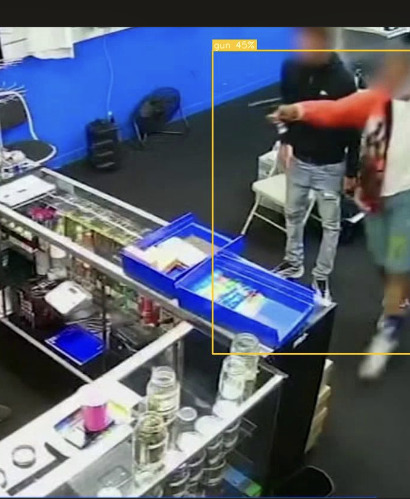
Underneath the marketing language, AI weapon detection is a computer-vision object-detection model — the same general family of technology used for detecting cars in a parking lot or defects on a production line, retrained on a dataset of firearms and edged weapons in a wide range of poses, lighting conditions, distances and partial occlusions. The model is looking for visual signatures: the silhouette of a handgun's slide and grip, the elongated profile of a rifle held at various angles, the outline of a blade. It doesn't understand intent, doesn't know who's holding the object, and has no concept of "threat" as a human would define it. It scores pixels against patterns it was trained to recognize.
That distinction matters because it sets expectations correctly from the start. The model is a pattern-matching system operating on a two-dimensional video frame — it will do that job well within the conditions it was trained and tuned for, and it will struggle exactly where you'd expect a pattern-matcher to struggle: unusual angles, partial visibility, objects that resemble weapons but aren't (a black umbrella held a certain way, a smartphone extended at arm's length, a tool on a job site), and objects that don't visually resemble a weapon at all until the moment it matters.
Every detection produced by the model comes with a confidence value — typically expressed as a percentage — representing how strongly the visual pattern in that frame matches what the model was trained to call "weapon." A system that reports detections as a binary yes/no is throwing away the most useful piece of information it has. A 96% confidence detection on a clearly visible handgun and a 61% confidence detection on a dark, partially obscured object at the edge of frame are very different events operationally, and a system worth buying treats them differently — routing the first as a high-priority alert and the second as a lower-priority flag for a human to glance at, rather than firing the same siren for both.
This is also where the threshold-tuning conversation with a vendor actually matters. Set the confidence threshold too low and the system fires on umbrellas, tools and shadows. Set it too high and it starts missing real detections in imperfect conditions. There is no universally correct number — the right threshold depends on the camera's field of view, typical scene activity, and how much operator attention the site can afford to spend reviewing borderline alerts. Any vendor who can't explain how their threshold is set, or who insists the number is fixed and untunable, hasn't thought hard enough about how their own system behaves at the edges.
A single video frame is a snapshot, and snapshots lie. Motion blur, momentary occlusion, a reflection, a compression artifact — any of these can produce a false match in one frame that vanishes in the next. A well-built weapon-detection pipeline doesn't alert off a single frame; it looks for temporal consistency, meaning the same object needs to be detected with reasonable confidence across a short sequence of consecutive frames before the system treats it as a real event. This does add a small amount of latency — usually a fraction of a second — but it's the single most effective lever for cutting false positives without raising the confidence threshold and risking missed detections.
Think of it as the difference between "I saw something that looked like a gun in one frame" and "I've been tracking an object that consistently matches the visual pattern of a gun for the last several hundred milliseconds, across multiple angles as it moved." The second is a materially more trustworthy signal, and it's the standard any serious weapon-detection module should be held to.
This is the distinction that gets flattened in most vendor pitches, and it's the one that matters most operationally. A high-confidence, temporally consistent weapon detection tells you: a visual pattern matching a weapon was present in this camera's field of view. It does not tell you whether that's a threat, a false alarm, an off-duty officer's holstered sidearm, a security guard's issued firearm, a prop, or a toy. Turning "detected" into "verified threat" is a human judgment call — informed by context the camera doesn't have: who's authorized to be armed on that site, what else is happening in the scene, whether the person is behaving in a way that supports the visual signal.
Any system, ours included, that claims to autonomously distinguish threat from non-threat without a human confirming the alert should be treated with real skepticism. The honest and operationally sound design is human-in-the-loop: the model does the fast, tireless, always-watching part — scanning every frame of every camera, something no human operator can sustain — and a person makes the call on what happens next. That's not a limitation to apologize for; it's the correct division of labor between a pattern-matching model and human judgment.
Want to see the confidence scoring and alert routing on your own feed? 30 minutes, your cameras, no slide deck.
Book a demo →Being direct about limitations is part of evaluating this technology honestly, and any vendor unwilling to discuss them isn't worth trusting on the parts they do claim.
Any vendor claiming their system eliminates these limitations, rather than manages them, is overclaiming. The right question in a vendor evaluation isn't "does it ever miss" — every system does — it's "how does the vendor talk about where it misses, and what's the fallback."
This is the part of the pitch that gets skipped most often, and it's arguably more important than the detection accuracy number itself. A detection with no fast, clear path to a human decision-maker is close to worthless — it's a log entry, not a security outcome. The operational question to ask any vendor is specific: from the moment the model crosses its confidence threshold, what is the actual alert path? Who receives it, on what device, with what information (a snapshot, a short clip, the camera location, a confidence score), and how fast?
On Vengeea's platform, detection routes to the operator dashboard and configured alert channels — typically within about two seconds from detection to the alert reaching a human — carrying the camera location, a confidence score, and a short clip so the person receiving it can make a fast, informed call rather than reacting blind. The system does not take autonomous action; it surfaces a fast, well-contextualized alert and leaves the decision with the humans responsible for the site's response protocol, whether that's dispatching a guard, contacting law enforcement, or triaging as a false alarm. That routing design — fast, contextual, human-decided — is what actually determines whether a weapon-detection deployment changes outcomes on the ground, far more than the last percentage point of model accuracy.
Weapon detection is one of Vengeea's live modules today, running in production alongside intrusion, face-match, fire/smoke and license-plate recognition — all processed on-premises on the customer's existing RTSP or ONVIF cameras, with no camera replacement required. It uses confidence scoring and temporal consistency checks as described above, and thresholds are tunable per camera and per zone rather than fixed globally, because a loading-dock camera and a lobby camera see very different baseline activity. Fight/aggression detection, theft detection and liquid-leak detection are separate modules currently in development — they are not part of the live weapon-detection pipeline and shouldn't be assumed to be available today.
On-premises, existing RTSP/ONVIF cameras, live in 1–3 days.